
The obnoxious railings of a hireling in a Youtube video prompted me to study the English word “church” and how it came to be the de facto translation for the Greek word “ekklesia“. It’s a question I’ve pondered for years if only because the New Testament was written 1,400 years before the word “church” came to be. That and my own observations of the way language has evolved over the course of my lifetime. Turns out the Greek word “Ekklesia” refers to the people whom Christ has called out of the world unto Himself whereas the English word “church” refers to the building where the people meet. Where it piques my curiosity has to do with translation, the essence of which is to match words from one language to another to faithfully and accurately convey the meaning of the original text. That the original Greek word differs in meaning from the English word strikes me as an error in translation.
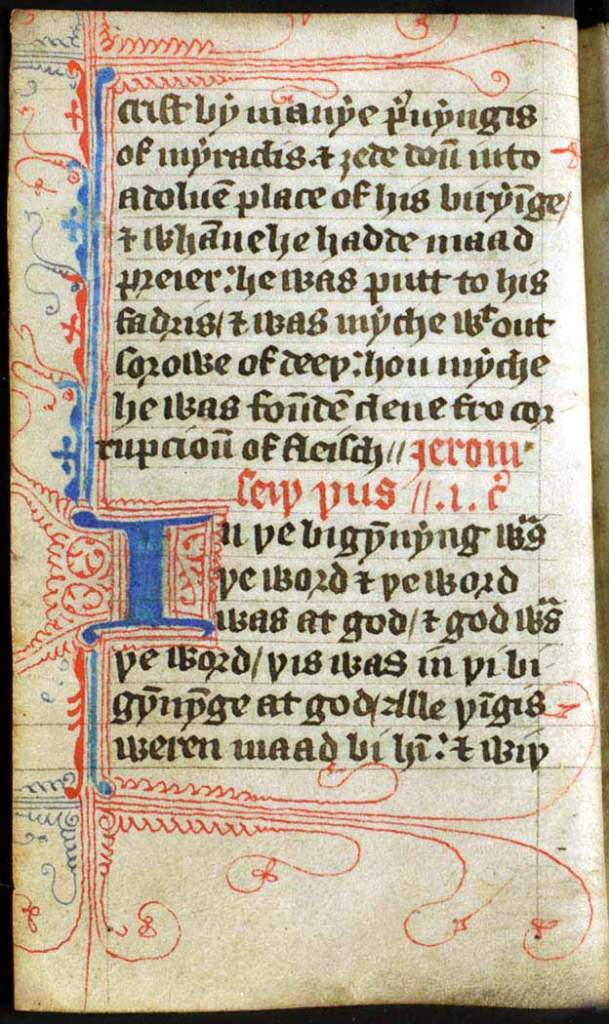
If you didn’t know, the oldest most reliable transcripts of the New Testament are written in Greek. The oldest fragment is known as Papyrus 52 and dates to 125-175 AD. The oldest complete codex (book form) of the New Testament is known as Codex Sinaiticus which dates to 330–360 AD. Not until 1382 AD was there a Bible in English, translated by John Wycliffe from the Latin Vulgate Bible. The first English New Testament translation sourced directly from Greek manuscripts dates to 1525 AD, thereby, averting the Roman Catholic influence and control inherent in the Latin Vulgate Bible. William Tyndale, the first person to translate the Bible from Greek to English, was very particular about how he translated the word “ekklesia.” He consistently translated this word as “congregation.”
The word “church” (1500s) was still evolving when the Wycliffe Bible was published in 1382. For more about that, Etymonline.com attributes church to the merging and evolution of the old English word chirche and the German word kirche which refer to “the Lord’s house.” Comparatively, the meaning of the Greek word ekklesia has been stable over the 2000 years that the English language has been evolving since Christ. Ekklesia has always retained the emphasis on people – specifically – a gathering of people (congregation).
As for my own meager study efforts, the word “ekklesia” appears 116 times in the New Testament. Only 3 of 116 uses of “ekklesia” came from the mouth of Jesus- once in Matthew 16:18 and twice in Matthew 18:17. The remaining 113 uses of “ekklesia” are in Acts through Revelation which were written by the apostles. Frankly, I believe it is an error to put the word “church” into Jesus mouth for reasons outlined below.
For starters, Jesus read Hebrew and likely conversed in Aramaic which was the regional dialect of Galilee. Historians and scholars tend to agree that when scripture was read in the synagogues, it was in Hebrew, the language of the scrolls. It was customary for the reader to follow the Hebrew language reading with a paraphrase in Aramaic followed by the reader’s commentary on the passage. Greek was the language of Israel’s oppressor, Rome, and while Jesus knew enough Greek to speak with the Centurion, Pontius Pilate, et al, conversational Greek with a Roman had more to do with responding to the governing authorities or when transacting business – buying, selling and tax collection. Thus I’m not convinced Jesus would use the Greek word “ekklesia” with His own people who spoke Aramaic. Nevertheless, our English Bibles are littered with the word “church” which at best is a poor translation from the word “ekklesia“. Thus I want to focus on the scriptures where Jesus is purported to have said “church“.
Jesus first use of the word “church” is found in Matthew 16:18:
Jesus said: “You are Peter, and upon this rock I will build My church.”
Unmasking the Greek words behind Peter, rock, build and church, is this:
“You are petros and upon this petra I will oikodomeō My ekklesia.”
Here’s what those unmasked words mean according to Strong’s Greek Dictionary:
“You are petros (a piece of rock) and upon this petra (large mass of rock (aka Jesus)) I will oikodomeō (build up, edify, embolden) My ekklesia (congregation).”
Since Jesus was speaking to Simon Peter, using the metaphor of 2 rocks, small (Simon) and large (Jesus), I think it’s more than fair that we look to Peter’s letters to see how Peter understood Jesus. The beloved dog-paddling apostle writes in 1 Peter 2:4-9:
Peter said: “As you come to him, a living stone (petra) rejected by men but in the sight of God chosen and precious, you yourselves like living stones (petros) are being built up (oikodomeō) as a spiritual house (ekklesia), to be a holy priesthood (ekklesia), to offer spiritual sacrifices acceptable to God through Jesus Christ. For it stands in Scripture: “Behold, I am laying in Zion a stone (petra), a cornerstone (petra) chosen and precious, and whoever believes in him will not be put to shame.” So the honor is for you who believe, but for those who do not believe, “The stone (petra) that the builders rejected has become the cornerstone (petra),” and “A stone (petra) of stumbling, and a rock (petra) of offense.” They stumble because they disobey the word, as they were destined to do. But you are a chosen race (ekklesia), a royal priesthood (ekklesia), a holy nation (ekklesia), a people (ekklesia) for his own possession, that you may proclaim the excellencies of him who called you out (ekklesia) of darkness into his marvelous light. (1 Peter 2:4-9 ESV)
All things considered and to put what Jesus said to Simon in perspective by using a modern colloquialism, what Jesus said to Simon Peter amounts to “Simon, you’re a chip off the old block (Me), whereupon I will (re)join you to Me together with all who believe in Me. Beginning with you, Simon, I will assemble a spiritual tabernacle for Me to inhabit on earth now and forevermore”. Thus finally, the Father’s wish to dwell among His people and be their God, is fulfilled in Christ. The spiritual tabernacle that Jesus is assembling with each of us, added to the Father’s kingdom one by one, are each new rooms in the Father’s ever-expanding mansion.
Another thought about what Jesus said to Peter in Matthew 16:18 is that it’s a real stretch to suppose Jesus gave Simon the new, proper English name of “Peter”. Within the definition of petros is a beautiful clue as to what the Lord is doing with us, but obscured by the dubious translation of petros to Peter. Strong’s Greek dictionary defines petros as a piece of rock. So where does a piece of rock (petros) come from but from a larger rock – a great mass of rock (petra)? Picture Adam and Eve, created by God and brought to life by God’s own breath in His own image. Adam and Eve, in the garden, without sin, walking unafraid and in union with their Creator until came sin and separation. Sin, the terrible cleaving event that created division between Creator and creation – petros (living stone) separated from petra (our Creator). Thus Jesus expressed to Simon His intent through Simon’s belief and trust in Jesus, to re-join fallen man to Himself. Petros (man) rejoined to Petra (God – the source of life everlasting and our Rock of Salvation).
Elsewhere in Revelation, it does say that the Lord will write His name on us – but that I believe simply means He will conform us to His likeness and character. He will simply remake us in His image where we are clothed in Christ and therefore bear His name.
In working this out, there was a delightful finding that put a smile on my face. GotQuestions.org says:
The early Quakers, as a matter of principle, refused to call the buildings where they met “churches,” since the biblical word church referred to people, not a building. The Quakers instead called a building designed for Christian worship a “steeplehouse.”
All this does beg the question how the NT come to be written in Greek, where the oldest fragments and most complete New Testament codex date to 125 -360 years after Jesus. I do wonder if there were ever a written Hebrew or Aramaic version of the gospels before they were translated to Greek. Or did the Bible writers simply decide to capture the gospel as shared in the oral tradition in Greek language scrolls? The Bibles we have today are at best a 3rd generation translation (Aramaic > Greek > English). The Wycliffe Bible is a 4th generation translation (Aramaic > Greek > Latin > English) since it was sourced from the Latin Vulgate. Where translations can be shown that word choices are not faithful to the original text gives me pause when claiming the Bible to be perfect and infallible. Ekklesia to church is just one dubious translation I’ve found that affects 116 verses of scripture. Of course I don’t let it ruin my faith because with study and teaching from the Holy Spirit, together with the present sweet fellowship of Jesus, the original truth is revealed. Whether an honest mistake or deliberate manipulation to consolidate power and control – that’s for the Lord to decide. It’s only the truth I’m after and to work out my faith before the Lord that it might be found acceptable in His sight.
As for the other scripture where Jesus supposedly used the word church, I see NO reason not to follow William Tyndale’s example and translate ekklesia as “congregation”. That makes sense to me because the context is ‘tell it to the people’ not ‘bring it to the building’.
Jesus: If he refuses to listen to them, tell it to the church congregation. And if he refuses to listen even to the church congregation, let him be to you as a Gentile and a tax collector. (Matthew 18:17 ESV)
In other words, put the unrepentant sinner out of the congregation, like Paul instructed in 1 Corinthians 5:11-13, so as not to defile the congregation (body of Christ).
Rock on! ;^)
Discover more from The Sons are Free
Subscribe to get the latest posts sent to your email.

