
NOTE: This article is a follow up to the article Martha! Martha! Martha!
I’ve been inspired to read Acts 6:1-6 in several different translations where I picked up on a few additional cues that raised even more questions concerning the creation and ordination of deacons.
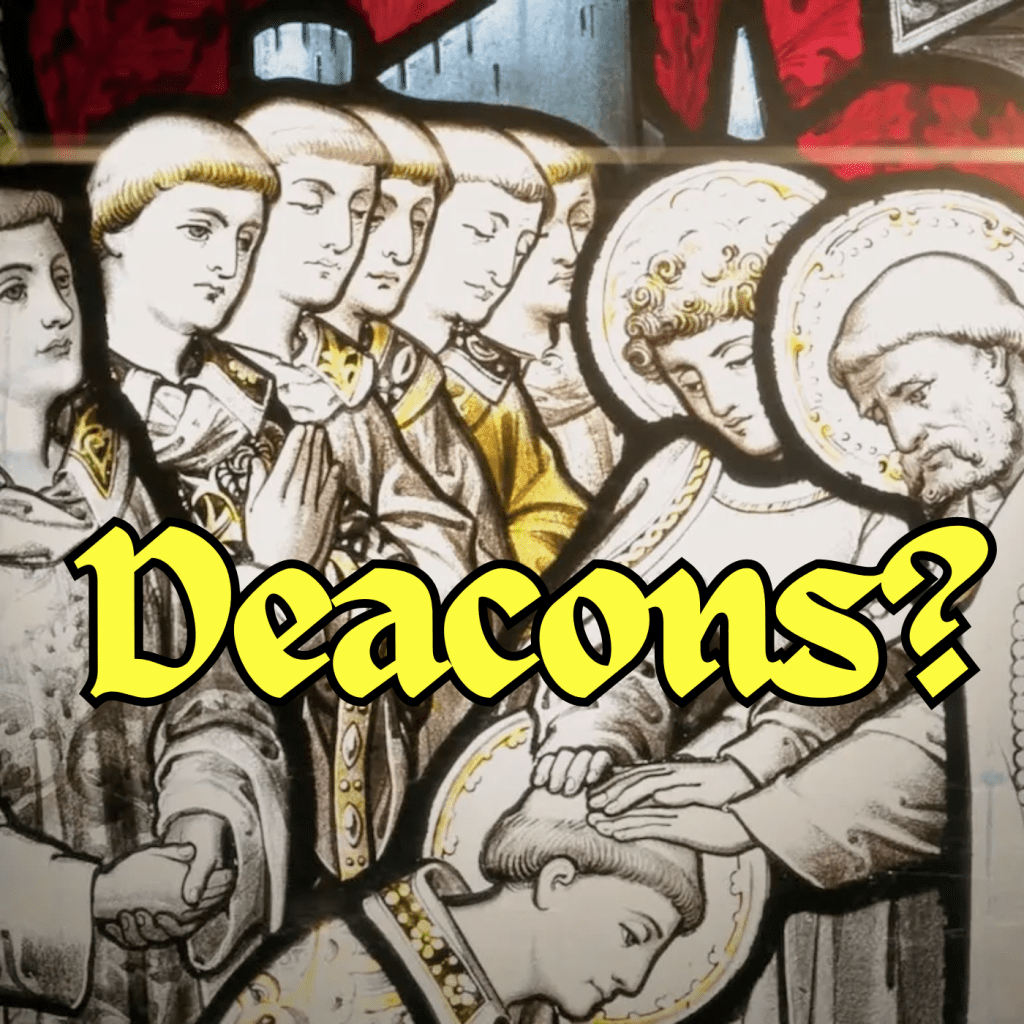
Normally, I use the ESV version for casual reading, which for Acts 6:2, reads in part:
“And the twelve summoned the full number of the disciples …”
The word “summoned” jumped off the page at me and leaves me rather unsettled, because it is often used in situations of authority, e.g., a court of law summons someone under the law to stand before the judge. Strong’s dictionary defines the Greek word προσκαλέομαι (proskaleomai / pros-kal-eh’-om-ahee) G4341 as:
“to call toward oneself, that is, summon, invite”.
I lean toward the translation of “summoned” over “invited” or “called” for the simple reason that it involved the “full number” of the disciples suggesting that their presence was expected. Had it been an invitation or call, I would expect some but not all to have shown up.
Another thing I observed in Acts 6:2 this morning, is the apostles’ counter-complaint. The variety of translations in the 46 English Bibles in eSword, gives me the impression that the translators are sugar-coating the literal meaning of the passage. One says:
… It is not fit that we should forsake the word of God, and serve tables. Another:
… It is not right for us to give up preaching the word of God in order to make distribution of food. Yet another:
… It is not reason that we should leave the word of God and serve tables.
Not one of the translations say anything remotely like “It is not the will of God” that we should sacrifice preaching the word to wait tables. Rather, the apostles seem to be asserting themselves by answering the complaint in Acts 6:1 with a counter-complaint followed by their ‘take it or leave it’ proposal. About the complaint, the Bishops Bible from 1568 puts it like this: “there arose a grudge among the Greeks against the Hebrews, because their widows were despised in the daily ministration.” That and other translations suggest to me the underlying message in the apostles reply seems to be “we’re done with serving tables”.
In that vein, the English Majority Text (EMTV) translation reveals an emotional undercurrent to it all:
“… It is not pleasing to us that we should forsake the word of God to serve tables.”
The word “pleasing” is translated from the Greek word “arestos” (G701) which means agreeable, fit, pleasing, reason”.
In saying that serving food is not agreeable or pleasing, the apostles counter-complaint and proposal would seem to be about their own will more so than God’s will.
About the time I reached the conclusion that the apostles acted in their own interests, I felt a big HOWEVER! in my spirit.
In defense of the Apostles, serving food may be like any number of seemingly good works that men undertake in the name of Christ, that once performed and enjoyed by the people, becomes tradition, “a thing” that takes on a life of its own and in time, demands the people serve IT! – celebrate IT! Serving up a common meal to the whole ekklesia, people selling off their possessions, donating the proceeds for the body and all the new disciples living with the apostles in a kind of communal arrangement described in the final few verses of Acts 2 and 4, may never have been intended by the Lord.
The back story in this passage may be that breaking bread, done in remembrance of the Lord, morphed into the “Good News Cafe” and quickly became a burden to the Apostles. Consequently the apostles response to the new disciples may have been to simply divest themselves from the part that did not originate with the Holy Spirit in the first place but nevertheless managed to suck the apostles into the busy-work of serving food. If that’s an apt assessment, then the apostles simply turned the service back to the people who demanded IT!
Morphing into an IT! may be the reason the Lord permitted the severe persecution of Acts 8:1 to come upon them in order to break up their little enclave. The Lord did, after all, charge the apostles in Matthew 28 with the words “go ye therefore into all the nations” with the good news of the kingdom and make disciples of all nations. So what were they doing cloistering in Jerusalem? Did Jesus have to call yet another apostle, Paul, to find someone willing to “go to the nations” like He commanded them in the first place?
I don’t think it’s unreasonable to suppose that the apostles capitulated to the people in the matter of serving the common meal and in so doing, institutionalized the ministry of Martha: Deacons. I draw comfort from that conclusion inasmuch as I too have been sucked into what on the surface seemed like a worthwhile good work for the Church, only to become consumed by IT! over time. In the past my wife and I both have come to the shocking decision “ENOUGH!” and abruptly quit a work we were heavily involved in, in order to get back to the simplicity of the gospel.
For example, I’m a performing songwriter of original Christian tunes. The Lord blessed me with a fruitful concert ministry for many years. Yet in my home church, never was I invited to sing one of my original songs during worship service. But! The music minister used me as a “guitar player” in the praise band and as a baritone in the choir. Quickly I found myself at church up to 10 hours per week on Wednesday, Saturday and Sunday for practice and services which occasionally interfered with my weekend concert schedule or recording projects. And when not at the church, I practiced at home for church! Yes, I was very busy at music for the church I attended, just never any of the anointed songs the Lord gave me.
ENOUGH!
That’s what I think I hear in Acts 6:1-6 now; the apostles simply had ENOUGH of the busy-work that consumed them and divested themselves of that which had been foisted upon them by the expectations of a rapidly growing and immature Church. Faced with the decision to either kill IT! outright or delegate IT! to the people who demanded IT!, they delegated.
ONE FINAL THOUGHT
Serving the common meal to the burgeoning Church of Acts 6:1-6 not only revisits the lesson of Martha and Mary upon the apostles; it also revisits the miracle of feeding the 5,000 described in John 6. After everyone ate their fill of the loaves, the disciples sailed from Tiberias to Capernaum and Jesus followed. When the crowd realized Jesus had left, they made their way to Capernaum as well, some by boat, others on foot. When they met up with Jesus again, He knew they only wanted to fill their bellies and so admonished them to pursue spiritual food that endures to eternal life (John 6:26-27). Jesus went on to tell them that He was the bread of life (John 6:35) and sadly, “many left him” (John 6:66) when He didn’t replicate the miracle of the fish and loaves.
Trying to turn the hearts of people from physical food to spiritual food, caused the crowd to take offense and leave, where only the 12 remained with Jesus (John 6:67-70). Having been witness to what happened in Capernaum, the apostles may have capitulated to the people on the distribution of the daily meal (loaves), rather than kill the beast outright and cause another mass exodus.
Discover more from The Sons are Free
Subscribe to get the latest posts sent to your email.
 The Sons are Free